Play-Based Therapy: Turning Play Into Meaningful Movement
Play is one of the most powerful tools for supporting learning and development. For children and individuals with neurodevelopmental conditions, particularly Autism Spectrum Disorder (ASD), play can also become an effective therapeutic strategy. Play-based therapy uses structured activities that feel like games while targeting meaningful physical, cognitive, and behavioural outcomes.
In Exercise Physiology and allied health settings, play based approaches allow participants to develop strength, coordination, and confidence while remaining engaged and motivated. Rather than viewing therapy as “exercise,” participants experience it as adventure, imagination, and challenge.
Research shows that structured physical activity and movement based interventions can improve motor skills, social engagement, and emotional regulation in individuals with autism (Bremer et al., 2016; Lang et al., 2010). When therapy incorporates play, participation and motivation often increase significantly.
Why Play-Based Therapy Works
Play naturally encourages movement, exploration, and problem solving. For many individuals with autism or other developmental conditions, traditional exercise may feel repetitive or difficult to engage with. Play changes this by embedding therapeutic goals within enjoyable activities.
Play based therapy can help develop:
Gross motor skills such as balance, coordination, and strength
Cardiovascular fitness and physical endurance
Executive functioning skills including planning and task completion
Social interaction and communication
Emotional regulation and behavioural control
When therapy feels fun and meaningful, participants are more likely to engage consistently and develop confidence in their abilities.
Using Imaginative Play to Encourage Movement
Imaginative play allows participants to become part of a story or scenario. This transforms exercises into missions or challenges, which can greatly increase motivation.
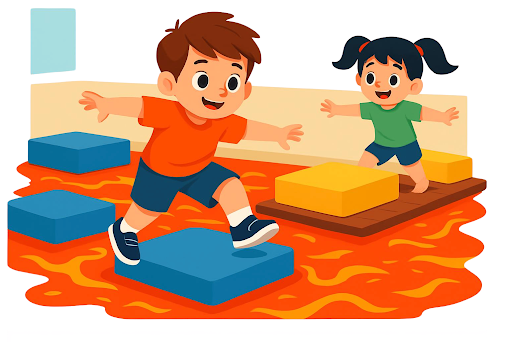
The Floor Is Lava
A classic example is the “floor is lava” game. The participant must move between safe zones such as mats, stepping stones, or platforms without touching the floor.
Therapeutic benefits include:
Balance and coordination training
Problem solving and spatial awareness
Lower body strength and stability
Confidence with movement
This activity can easily be adapted by increasing the distance between surfaces or adding obstacles.
Story Based Adventures
Creating a narrative around an activity can make therapy sessions feel like an adventure rather than a workout. The participant may need to complete different physical challenges to progress through the story.
For example:
Crossing a “river” using stepping stones
Crawling through a “cave” (tunnel)
Climbing over obstacles to reach a treasure
Each stage can target a specific physical skill such as crawling, jumping, climbing, or balancing.

Becoming Their Favourite Character
Many participants respond extremely well when therapy incorporates characters or themes they love.
For instance, one participant who enjoys Dragon Ball Z imagined he was the character Goku training to defeat a final boss. To reach the final challenge, he had to complete a balance obstacle course that included stepping stones, foam pads, and narrow beams.
Instead of simply performing balance drills, the participant viewed the activity as part of his character’s training. Engagement increased significantly, and he remained focused throughout the session.

Purposeful Movement Through Games
Another effective strategy is turning movement into a fast paced game that encourages both physical activity and cognitive engagement.
Colour or Picture Collection
Place coloured markers, pictures, or suction pods around the gym or exercise space. The participant must collect specific items as quickly as possible.
For example:
Collect all the red pods
Find all the pictures of animals
Gather items in a specific sequence
This activity develops:
Executive functioning
Decision making and planning
Cardiovascular fitness
Speed and agility
For participants who are very fidgety or hyperactive, this type of activity provides a productive outlet for excess energy. It redirects constant movement into a structured and meaningful task.

Additional Play Based Therapy Ideas
Reaction and Speed Games
Quick reaction games encourage focus and attention.
Examples include:
The participant runs to different coloured cones when a colour is called
A therapist holds up different pictures and the participant must run to the matching station
Stop and go games that encourage impulse control
These activities promote cardiovascular fitness while also improving reaction time and concentration.
Treasure Hunt Activities
Hide objects around the room and provide clues for participants to find them. Each clue may involve a movement task such as:
Five jumps before receiving the next clue
Balancing on one foot for ten seconds
Crawling under a barrier
Treasure hunts combine physical activity with problem solving and imagination.
Creating Meaningful Outcomes Through Play
Play based therapy is more than just games. When activities are designed with intention, they can address key developmental areas such as motor skills, executive functioning, and emotional regulation.
For many participants, especially those with Autism Spectrum Disorder, traditional exercise programs may not always be engaging. Play allows therapists to meet participants where they are, using their interests and imagination to guide meaningful movement.
When therapy feels like play, participants are more likely to stay engaged, build confidence, and develop skills that transfer into everyday life.
References
Bremer, E., Crozier, M., & Lloyd, M. (2016). A systematic review of the behavioural outcomes following exercise interventions for children and youth with autism spectrum disorder. Autism, 20(8), 899–915. https://doi.org/10.1177/1362361315616002
Lang, R., Koegel, L. K., Ashbaugh, K., Regester, A., Ence, W., & Smith, W. (2010). Physical exercise and individuals with autism spectrum disorders, A systematic review. Research in Autism Spectrum Disorders, 4(4), 565–576. https://doi.org/10.1016/j.rasd.2010.01.006